
Lakeshore Drive

I wrote “Lakeshore Drive” in 2011, at the peak of my addiction, and it came out of one of those nights where everything blew up again. I had just left the bar after another stupid argument with the person the poem revolves around. We never dated, never committed to anything, but we had that volatile chemistry—half attraction, half irritation, and a whole lot of banter that made everything feel dramatic and bigger than it was. It was toxic and familiar, and I kept going back because I didn’t know how to want anything healthier.
I didn’t know when I wrote this that the Lisa Vicious era was ending. I was still right in the middle of it—writing Love Letters & Suicide Notes, living like chaos was a personality trait, thinking that being wrecked meant being authentic. “Lakeshore Drive” wasn’t written as closure; it was written because I was drunk, hurt, and trying to turn a bad night into something that sounded like a punk ballad.
I was deep into California punk back then—Social Distortion, X, all that rockabilly grit that made heartbreak feel like it belonged on a stage. That aesthetic shaped the poem completely. And the wild part is: Exene Cervenka actually read this one and said it was her favorite. I still can’t believe that. It’s surreal when someone who defined the sound and attitude of an era reads something you wrote on the way home from a bar and calls it “magical.” It told me there was something real in my voice long before I believed it myself.
When I read it now, I can see how unhealthy I was—not just with drugs or alcohol, but with people, with attachment, with the way I kept myself small so no one could expect anything of me. But I also see the spark in the language, the rhythm I didn’t know I was capable of yet. “Lakeshore Drive” is messy, loud, a little tragic, and still one of the closest things to the truth of that era. It’s also one of the last things Lisa Vicious ever wrote, even if I didn’t know I was already writing my way out of that persona by 2023.
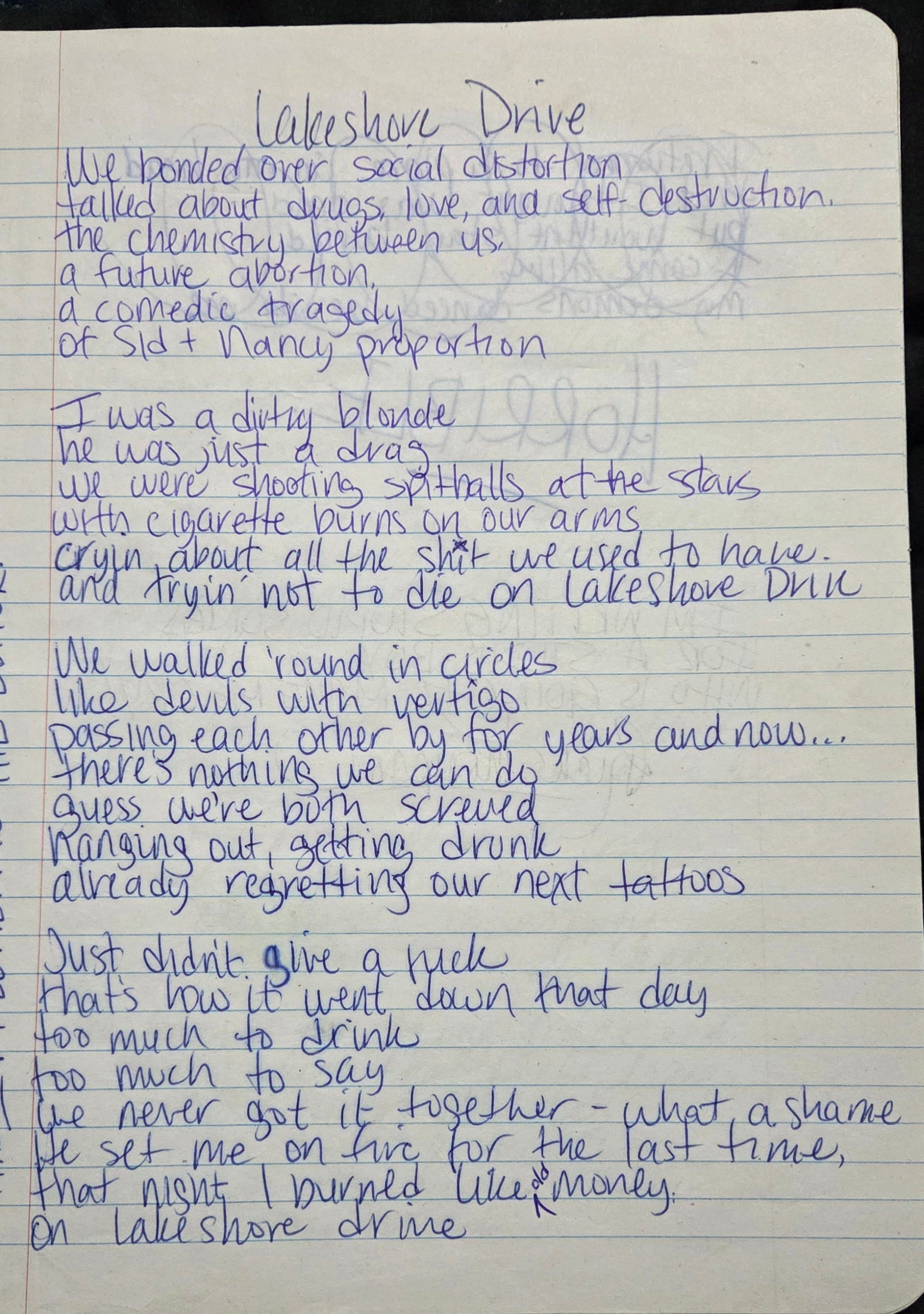
“Lakeshore Drive” from Love Letters & Suicide Notes.
Craft Analysis: “Lakeshore Drive”
“Lakeshore Drive” operates as a punk elegy for a relationship that never fully formed, built on equal parts nostalgia, recklessness, banter, and mutually inflicted damage. The poem blends the emotional volatility of late-night confession with a lyric structure that echoes the rhythms of California punk and early rockabilly. It’s a portrait of two people who mistake chaos for connection, rendered through sharply drawn detail and musical phrasing.
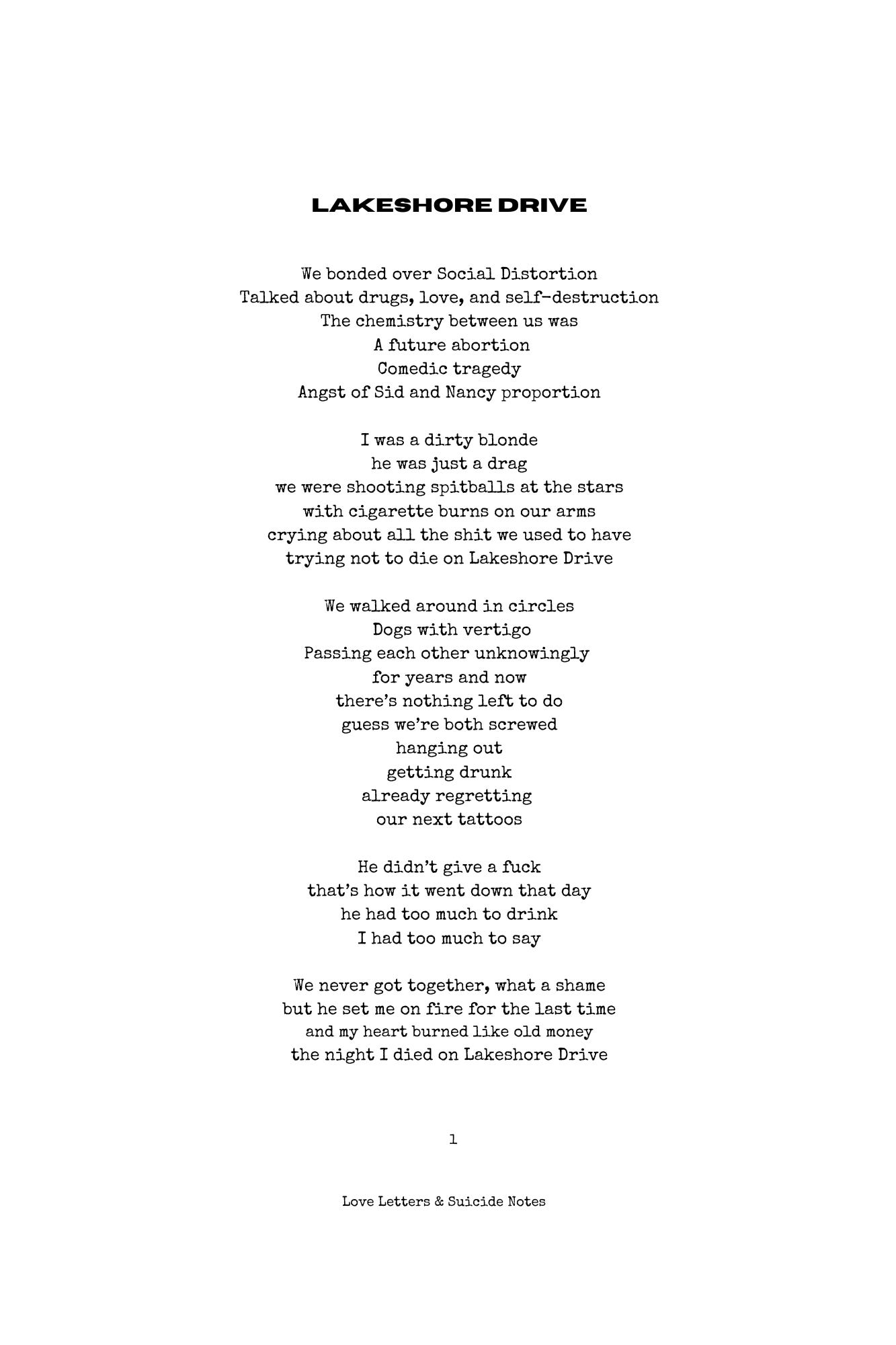
The poem opens with a declaration of shared affinity that sets the tone:
“We bonded over Social Distortion
talked about drugs, love, and self-destruction”
This establishes not only the emotional framework but the poem’s sonic landscape. The references aren’t ornamental—they function as cultural code, signaling the sub-cultural milieu and hinting at an aesthetic steeped in grit and melodrama. The triad of “drugs, love, and self-destruction” positions the relationship within a lineage of punk romanticism, where intimacy is both desired and doomed.
The next lines sharpen the self-awareness:
“the chemistry between us was a:
future abortion
comedic tragedy
angst of Sid and Nancy proportion”
The speaker uses hyperbolic metaphor and dark humor to map the dysfunction. The colon after “was a:” signals a shift into performance—a moment where the speaker dramatizes the relationship using references to catastrophe (“future abortion”) and mythologized toxic love (“Sid and Nancy”). These images anchor the poem in a self-aware cynicism, where the speaker both recognizes and indulges the instability.
The poem’s middle section turns toward confession and vulnerability:
“we were shooting spitballs at the stars
with cigarette burns on our arms
crying about all the shit we used to have
and trying not to die on Lakeshore Drive”
This is one of the poem’s strongest stanzas. The juxtaposition of childish imagery (“shooting spitballs at the stars”) with bodily harm (“cigarette burns on our arms”) reveals a pair of people stuck between youth and self-destruction. The closing line, “trying not to die on Lakeshore Drive,” transforms the setting into a metaphor for survival—suggesting that the poem’s geographical anchor is also the emotional battleground.
As the poem continues, the narrative voice becomes more resigned, even fatalistic:
“we walked around in circles,
dogs with vertigo
passing each other unknowingly for years and now…”
The metaphor of “dogs with vertigo” conveys disorientation and cyclical dysfunction. The ellipsis at the end of “and now…” invites the reader into that moment of suspended inevitability—the point where the speaker sees the pattern but lacks the power or desire to disrupt it.
The poem’s closing lines carry the emotional blow:
“he set me on fire for the last time
and my heart burned like old money
the night I died on Lakeshore Drive”
“Old money” is a surprisingly elegant simile for a punk-poetic voice; it suggests something that has been held onto too long, something that burns with the weight of history rather than the flash of impulse. “The night I died on Lakeshore Drive” is metaphorical death, not literal—a moment when the speaker allows an old self, an old persona, or an old attachment to collapse.
What makes “Lakeshore Drive” compelling is the tension between bravado and sincerity. The poem dresses its wounds in leather and eyeliner, but the emotional truth remains unfiltered. It captures a version of youth where self-destruction feels like intimacy, and where identity is shaped more by music and myth than by clarity.
The voice here is transitional—still performing chaos, still leaning into punk mythology, but already revealing cracks of maturity and self-recognition. It’s a poem situated at the threshold between persona and self, between recklessness and awakening, between the story being lived and the story being understood.
“Lakeshore Drive” is both a eulogy and a snapshot: a final, fast-burning Polaroid of the person the speaker used to be.
You can preview and purchase Love Letters & Suicide Notes at BenningtonLove.com

Intense analysis.